
The forecast says the wind is out of the north at 6 mph. You set up so north is in your face. Then a doe comes up the draw below you, stops, lifts her nose, and blows. You never saw a leaf move.
That's usually thermals. If you hunt anything other than flat ground, you need to understand them, because they don't care what the forecast says.
What a thermal is
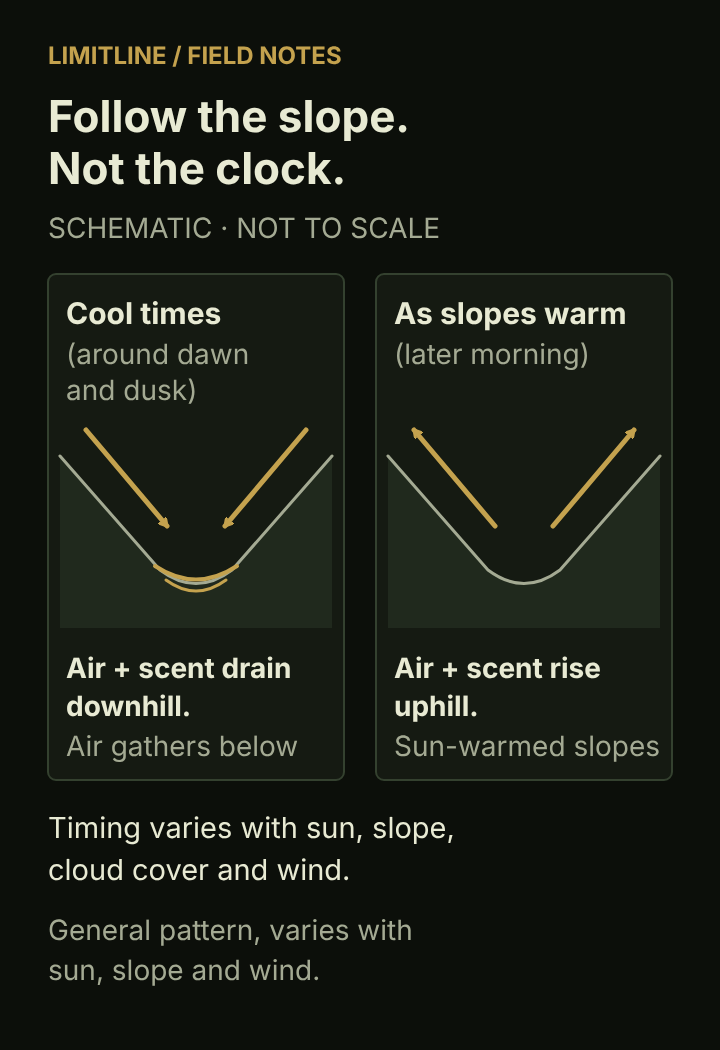
Thermals are air moving up or down a slope because of temperature. They're separate from the big weather wind the forecast talks about.
The Missouri Department of Conservation (opens in a new tab) explains it plainly. After the sun goes down, air cools and starts to sink. When the sun comes up and warms things, air starts flowing back up the valleys. MDC adds that these currents are "particularly pronounced on sunny days" and can cause serious swirl when they mix with the prevailing wind.
Meteorologists call this the mountain and valley wind system. MeteoSwiss (opens in a new tab), Switzerland's national weather service, describes it the same way. Sun-warmed slopes push air uphill during the day. At night, colder, heavier air drains downhill. It shows up mostly in calm, stable, high-pressure weather. They also note that the nighttime downslope flow is generally much weaker than the daytime upslope flow.
So the short version:
- Cooling air sinks. Evenings, nights, early mornings, and shaded slopes.
- Warming air rises. Once the sun hits the ground.
- Calm, clear days make it stronger. A stiff breeze can override it. A light one usually won't.
Why draws and creek bottoms are the hard part
Your scent goes where the air goes, and in the evening the air goes down.
The National Deer Association's piece on thermals (opens in a new tab) puts it in terms any hunter can picture. As the day cools toward dark, your scent ends up in the lowest spot around you, the same way fog and frost settle in low ground. If the lowest spot around you is the thicket where deer bed, you've just told them where you are.
MDC also points out that ridgetops tend to have the most consistent wind. Valleys and drainages are where prevailing wind and thermals get tangled and swirl. That's why the creek bottom that looks perfect on a map can be the hardest place to keep your wind.
Grant Woods, a deer biologist quoted in American Hunter (opens in a new tab), said creek bottoms can be good when the temperature drops and the thermals blow predictably. "But it's a short hunt," he said. "It only works for about an hour to 90 minutes till the sun pops up and warms the valley." That's one biologist's field rule, not a law. But it matches the physics.
The common rule, and its exception
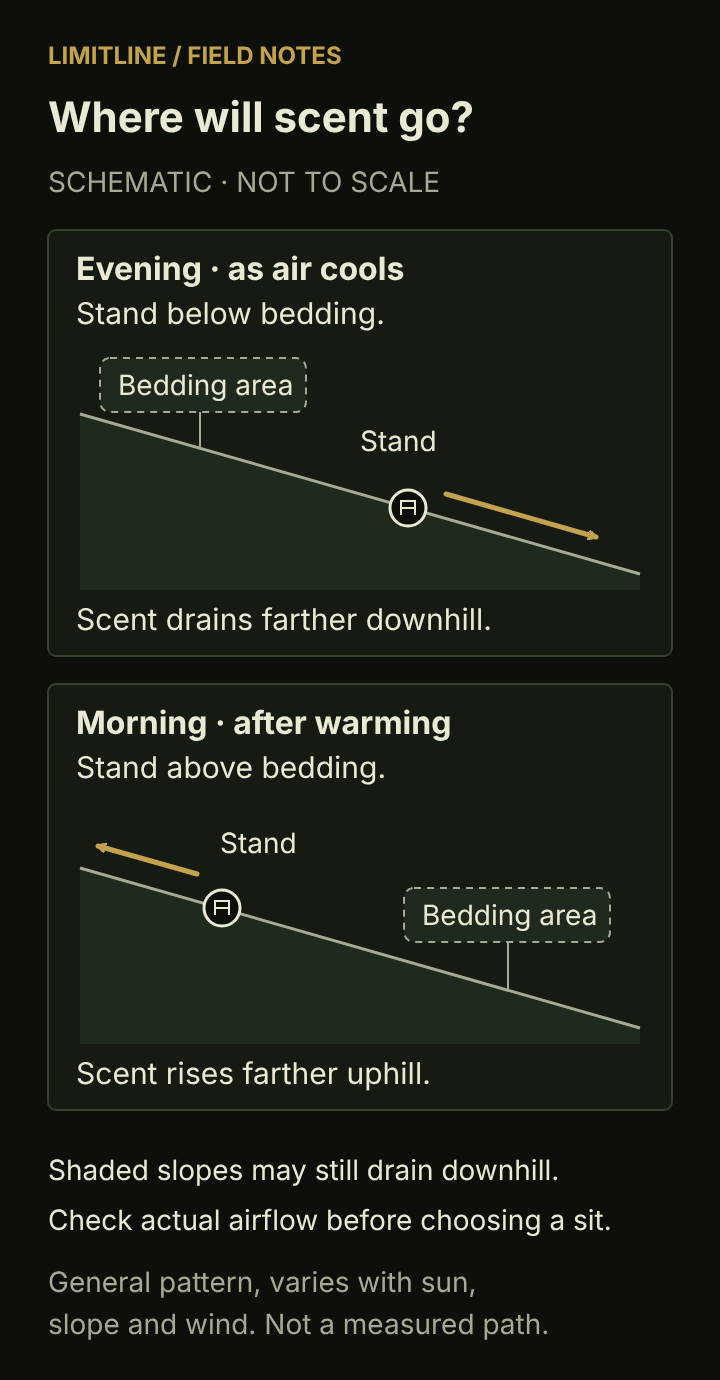
The NDA article gives the usual rule of thumb: hunt high in the morning, low in the evening. In the morning, rising air carries your scent uphill and away from deer below you. In the evening, sinking air carries it downhill, so you want to be below the deer you're hunting.
The exception is the one that gets people. The same article describes a stand a quarter of the way down a north-facing slope. The sun was on the ridgetop, but the shaded slope hadn't warmed yet. So the air there was still sinking at daylight, like it does in the evening, and scent drifted down toward the bedding. Once the sun got high enough to warm that slope, the air turned and started rising.
So it's not "thermals flip at 9 a.m." It depends on:
- Which way the slope faces. South- and east-facing slopes warm sooner. North-facing slopes and deep shade warm later.
- Cloud cover. On an overcast day the swing is weaker and less predictable.
- Wind speed. A strong prevailing wind can bury the thermal. A light one mixes with it and swirls.
- Where you sit on the slope. Top, middle, and bottom can all be doing different things at the same minute.
How to actually figure out your spot
You can't learn this from a map. MDC's advice is to spend time on your property in the off-season and watch how the wind changes through the day, because topography, cloud cover, and wind speed all play in.
A few ways to do that:
- Carry a puffer or milkweed and use it a lot. Check at the truck, on the walk, at the base of the tree, and every 15 to 20 minutes on stand. Watch where it goes after the first few feet, not just which way it leaves your hand.
- Notice the moment it turns. The NDA writer says you can learn to feel the switch: moisture building and air cooling as the sun drops. Write down the time.
- Note the conditions with the time. Clear or cloudy, wind speed, temperature, and which slope you were on. A thermal turn at 8:40 means nothing without the sky and the slope next to it.
- Compare after a few sits. You'll start to see that this stand turns late on clear mornings, or that this bottom swirls any time the breeze drops under a certain speed.
None of that predicts what a deer will do. It just tells you where your scent is going, which is the part you control.
A simple setup checklist for hill country
- Morning: get above where deer will be. Avoid the bottom once the sun is on it.
- Evening: get below, or off to the side of where deer will come from. Don't sit uphill of bedding as the air cools.
- Shaded or north-facing slope: expect the morning to act like evening for longer.
- Light, swirly wind in a drainage: think twice before you go in. Pick a different stand.
- Your walk in has thermals too. If you come down a draw at dusk, your scent is going ahead of you into the bottom.
Hunting methods, legal shooting hours, and scent rules vary by state. Check your state wildlife agency's regulations before you head out.
I build LimitLine. Its map has a Thermal Tendency Simulator that shows where air is more likely to rise or settle across a property through the day, modeled from slope, aspect, cover, sun and wind. It's planning guidance, not a forecast or a measured scent path, so keep using the puffer. Each sit you log keeps its stand, times, sightings and notes (like when the air turned), so you can compare sits instead of remembering them. See plans and how to start.
Sources
- Missouri Department of Conservation, "Stand Locations" (opens in a new tab)
- MeteoSwiss (Federal Office of Meteorology and Climatology), "Valley and mountain winds" (opens in a new tab)
- National Deer Association, "To Beat a Buck's Nose, Remember Thermals" (Anthony Harris, 2014) (opens in a new tab)
- American Hunter (NRA), "Deer Stand Burnout: Can You Avoid It?" (Patrick Durkin, 2015), quoting Grant Woods (opens in a new tab)