
The first three sits were great. Does at forty yards. A young buck slipping through the edge right at last light. Then nothing. Five sits, six sits, and the only thing walking by is a squirrel.
Every deer board gets this question every fall. "Where did my deer go?" The honest answer is that there are a handful of usual reasons, and they don't all have the same fix. Your job is to figure out which one is yours before you burn another week.
Reason 1: You hunted it too much
This is the one nobody wants to hear, and it has the best data behind it.
Researchers at Auburn put GPS collars on 37 bucks at a 6,400-acre property in the South Carolina Lowcountry. Each collar logged a location every 30 minutes from late August to late November. Then they lined those locations up against when each stand was hunted. Per the National Deer Association's write-up of Clint McCoy's study (opens in a new tab), the odds of a buck coming into a stand's harvest zone (the area a hunter could see and shoot from the stand) in daylight fell by half after about 12 hours of hunting at that stand in the previous week. On average, bucks avoided a stand for about three days after it was hunted.
Twelve hours is not much. That's three four-hour evenings.
The same study found something else worth knowing. After four or five days the avoidance faded. But the stand didn't go back to pulling bucks in the way it had before. Resting a stand helps. It doesn't wipe the slate clean.
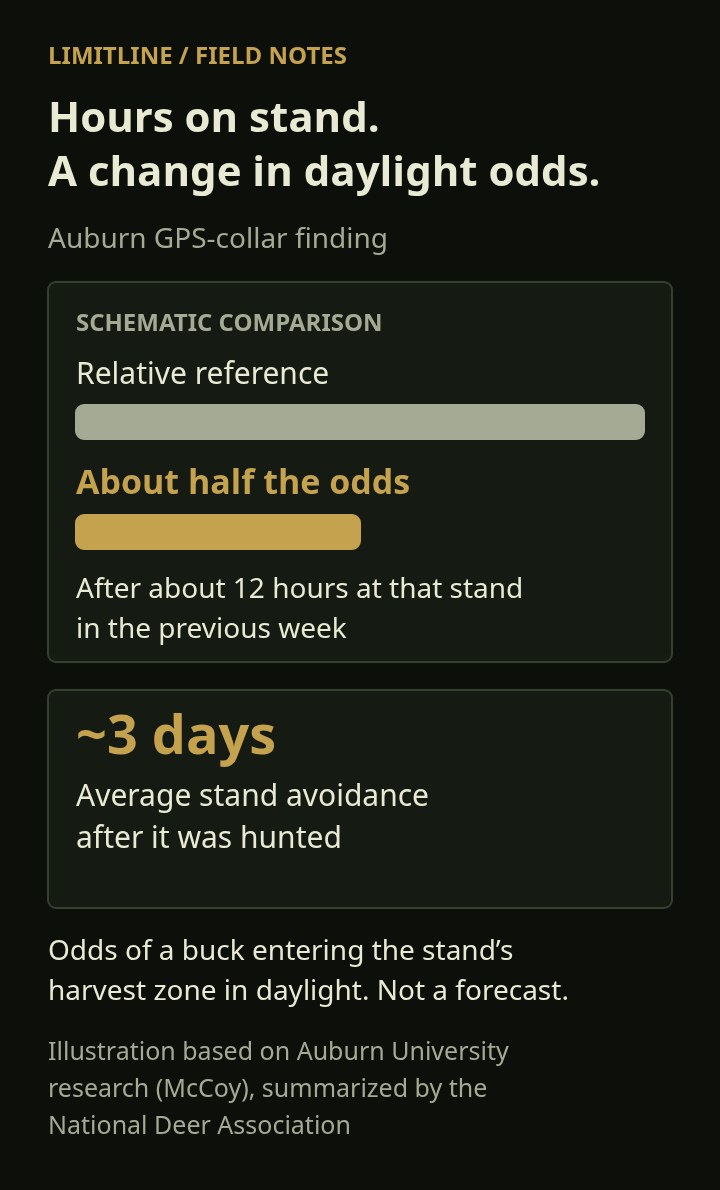
How to tell: Count your hours at that stand over the last seven days. Be honest. If it's double digits and sightings dropped as the hours climbed, this is probably your answer.
What to do: Spread your sits across more stands, and save the best one for the right wind and the right week.
Reason 2: The food moved
Deer go where the food is, and fall food changes fast. The Indiana DNR's scouting guide (opens in a new tab) names harvested crop fields and oaks dropping acorns as the most popular fall feeding areas. It also warns that deer start changing their habits once fall begins, so the information you gathered in August goes stale.
A beanfield that was the place to be in September can lose its draw once it's cut or the acorns start falling. Your stand didn't change. The deer's dinner plans did.
How to tell: Walk the nearby oaks at midday and look for acorns on the ground and fresh droppings around them. Check whether the field you were watching has been harvested. Fresh tracks headed somewhere other than your trail are a clue.
What to do: Find the new food. Then find the cover-to-food route that leads to it.
Reason 3: The rut changed the pattern
Bucks follow a bed-to-feed pattern most of the year. The Indiana DNR guide notes the exception: during the rut, bucks spend most of their time looking for does. The routine buck you had on camera in early October may now be covering ground you've never seen him on.
How to tell: Look at the calendar and your area's rut timing. Watch for more chasing, more fresh scrapes, and bucks showing up at odd hours on camera.
What to do: Shift toward doe bedding and the travel routes between doe groups. Stop waiting on a summer pattern that's gone.
Reason 4: Somebody else is in there
On public land, and on private ground with neighbors, the pressure isn't only yours. Penn State's Deer-Forest Study tracked collared deer through Pennsylvania's rifle season. Duane Diefenbach found (opens in a new tab) no evidence that deer moved less once the season opened. They kept moving. They just moved where hunters weren't. The study's summary post (opens in a new tab) describes deer that survive finding a "safe zone" inside their home range where hunters don't disturb them.
How to tell: Look for new boot tracks, flagging tape, other stands, or trucks at the lot on days you weren't there.
What to do: Look for the spots that are hard to get to.
Reason 5: Your walk is giving you away
You can sit a perfect stand on a perfect wind and still blow it on the way in. If your route crosses a bedding area or sends scent into it, deer learn that spot is trouble. The NDA's stand access guide (opens in a new tab) argues that access matters as much as stand location. Its author won't hunt a stand unless the wind is right for both the stand and the route in.
How to tell: Do you jump deer on the way in or out? Do you hear blowing behind you after you climb down? Those are signs.
What to do: Change the route before you change the stand.
The part that actually helps: write it down
Here's the trouble with every reason above. You can't sort them out from memory. Memory keeps the one good morning and drops the eleven where nothing walked by.
After every sit, write down a few things:
- Stand name, date, and start and end time
- Wind direction and speed, and whether it held
- Temperature and sky (clear, overcast, front coming)
- What you saw, what time, and which direction it came from
- Whether you bumped anything going in or out
- Any sign of other hunters
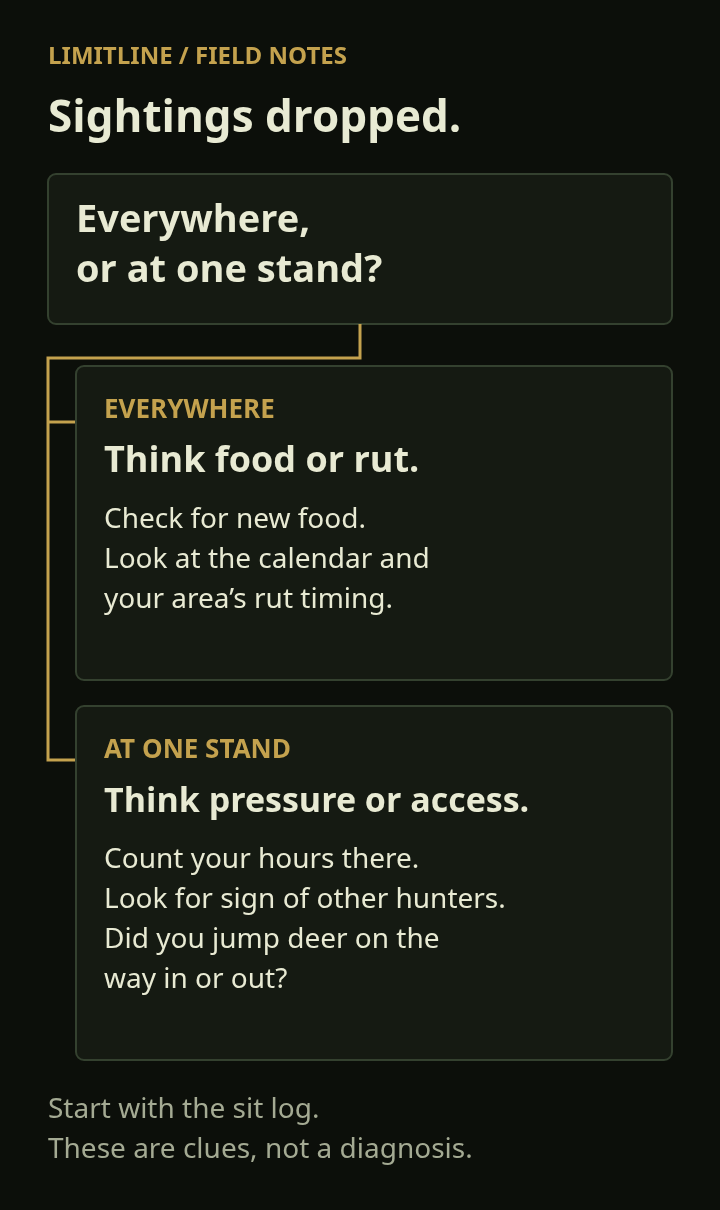
It takes two minutes in the truck. After a couple weeks you can add up your hours per stand. You can see whether the sightings fell off a cliff after a certain date, and whether they did it everywhere or just at one tree. If it's everywhere, think food or rut. If it's one tree, think pressure or access.
That's not a prediction. It's just the record of what happened, which is more than most of us have in November.
Season dates, legal hours, and land rules vary by state and by property. Check your state wildlife agency's regulations before you change how or where you hunt.
I build LimitLine. It logs each sit with its stand, start and end times, sightings and notes, plus an optional snapshot of the wind and temperature when you start. Journal Insights can total your hours and sightings at any one stand for the year, so you can see this pattern instead of guessing at it. See plans and how to start.
Sources
- National Deer Association, "How Fast Can a Stand Recover From Hunting Pressure?" (Clint McCoy, Auburn University) (opens in a new tab)
- Indiana DNR, "Deer Scouting Basics" (opens in a new tab)
- Penn State Deer-Forest Study, "Are there any deer in Pennsylvania during the gun season?" (Duane Diefenbach, 2021) (opens in a new tab)
- Penn State Deer-Forest Study, "The Ultimate Guide to Hunting Big Woods Deer" (opens in a new tab)
- National Deer Association, "How to Access Your Deer Stand Undetected" (opens in a new tab)